Live teaching three times a week, six practice sessions, office hours on your teen’s own schoolwork, and help on any stuck problem the same day — on whatever schedule their week allows.
Taught by our team of experienced AP coaches — founded by Allen Tsao (Electrical Engineering, UC Berkeley & Stanford).
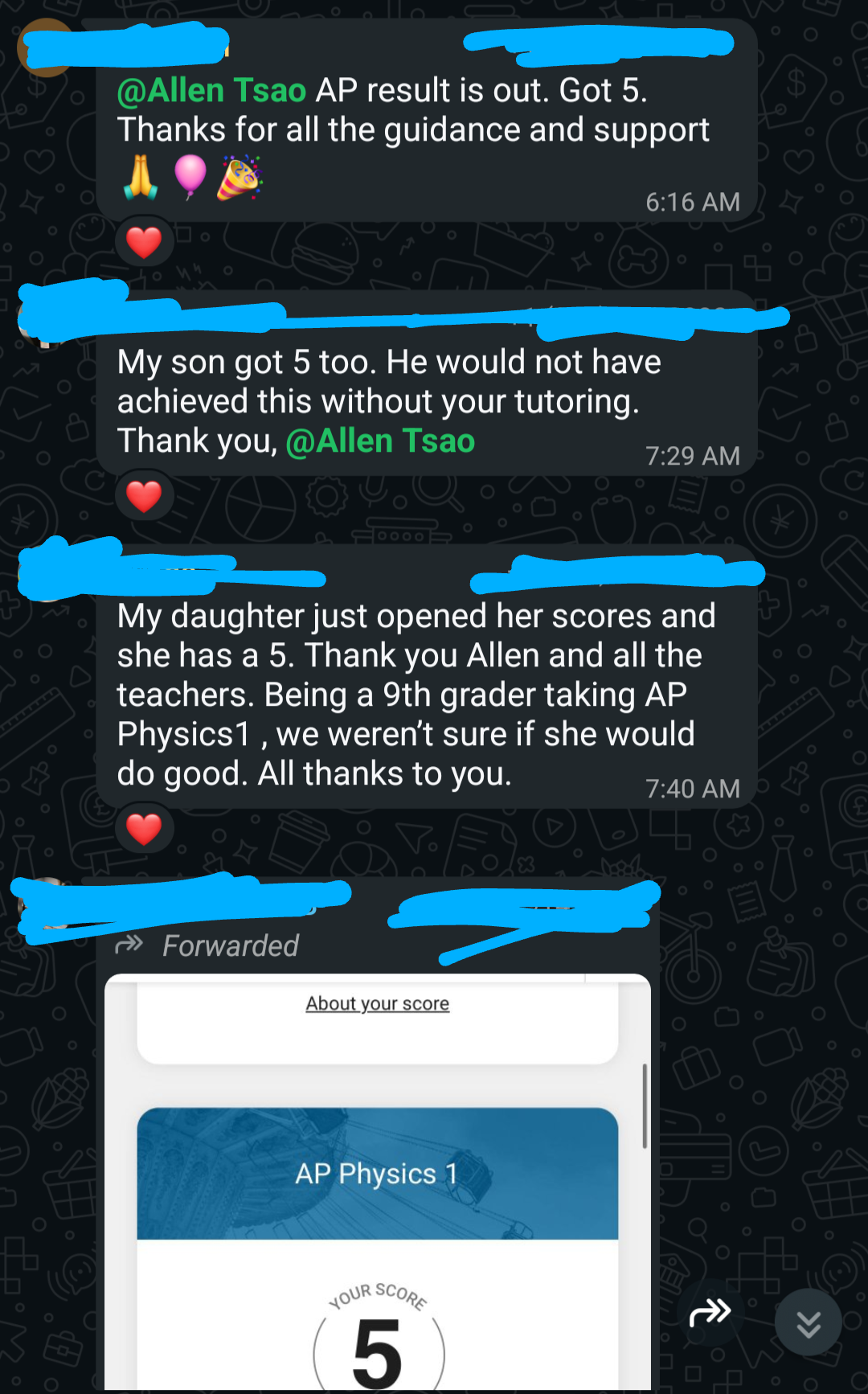
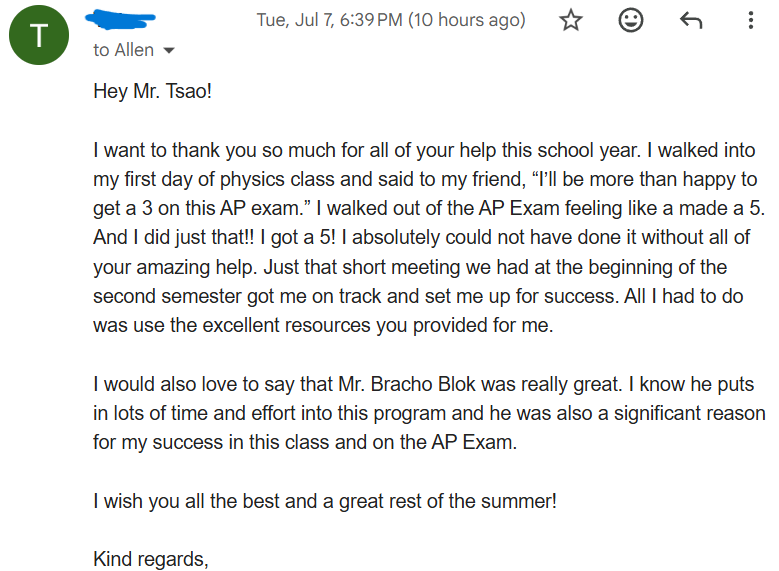
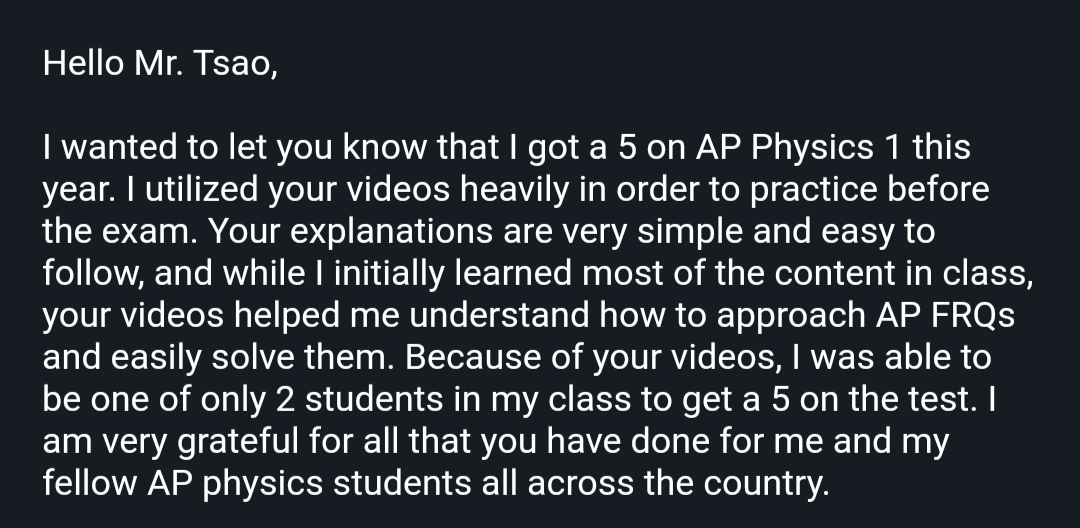
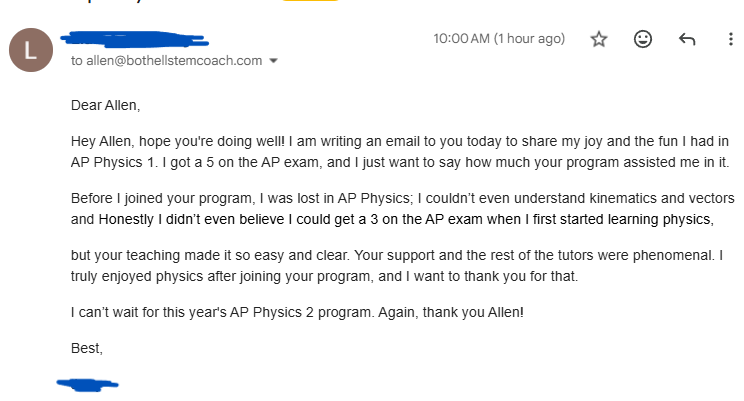
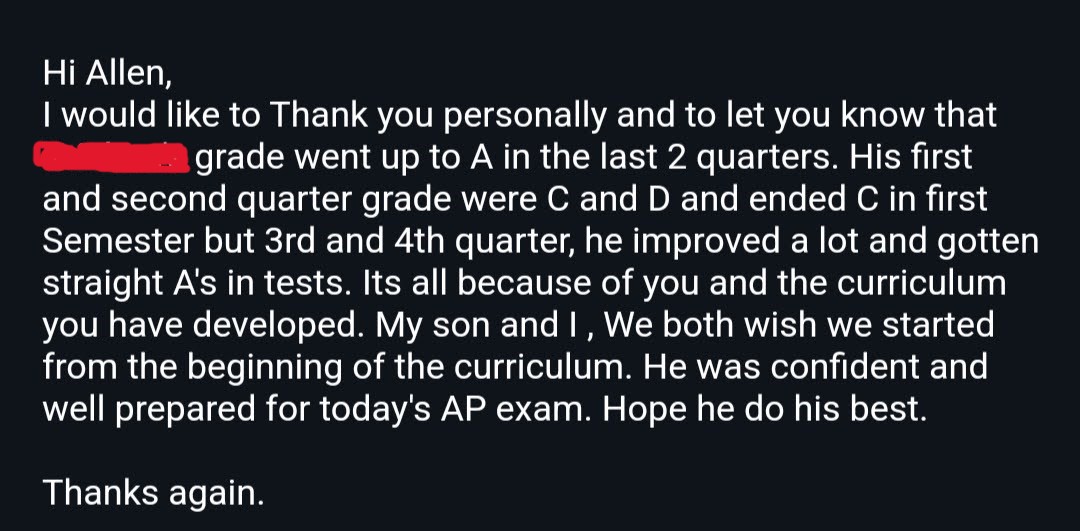
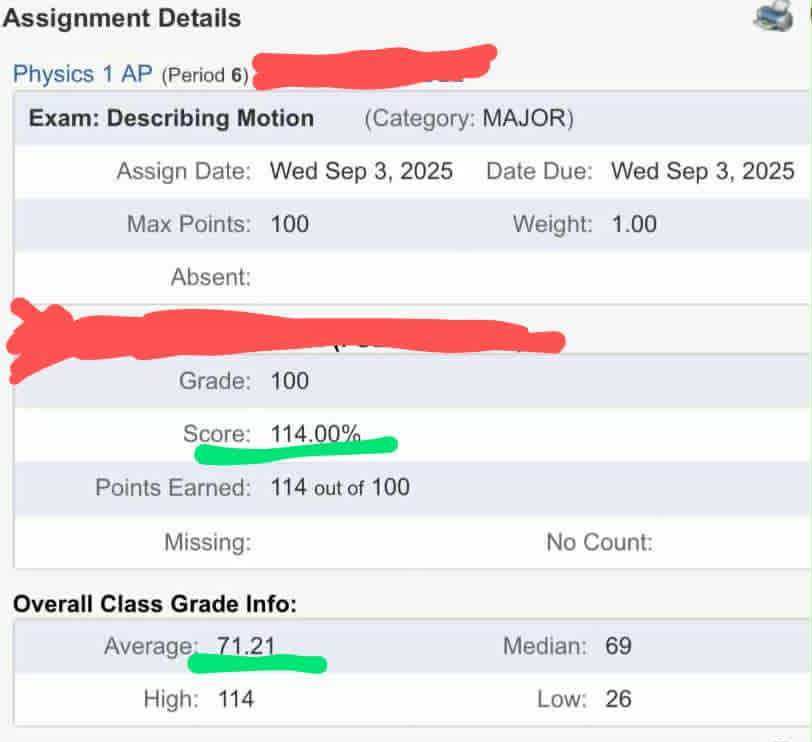
| 2026 AP Physics 1 Exam Scores |
5 | 4 | 3 | 2 | 1 |
|---|---|---|---|---|---|
| My Students | 60% | 33% | 7% | 0% | 0% |
| National Average | 19% | 24% | 25% | 15% | 17% |
AP Physics rewards a process, not memorization. For each unit — and each type of problem within it — we teach a clear, step-by-step way to work through it. So whatever shows up on the exam, students know exactly how to start. We cover all eight units from the ground up:
No tiers, no on-ramps, nothing to upgrade. $500 covers your teen's first 30 days of the School Year Program — everything included, from the day you enroll. At the end of the 30 days you decide whether to keep going, and what that looks like is something Allen goes over with you on a call.
You have two weeks to get every dollar back. We don't ask you to wait and hope — inside those first two weeks your teen gets their plan, sits in real teaching lessons, and gets real feedback on their own work. If they aren't moving, tell us before day 14 and we refund the full $500, as long as your teen has given it a real try: at least 3 actions from our list in the first 14 days (watching lessons, coming to a live class, submitting homework, and so on). You can see exactly where your teen stands in the parent portal. No fees held back. After day 14 the 30 days aren't refundable, and we don't do partial refunds — but you're never charged anything more unless you reply to that email and tell us to continue. If you have concerns at any point, reach out to Allen directly.
Everything is included — all the live teaching and practice, office hours, both practice portals, a success coach, and the six-week AP exam prep block from March. There are no tiers and nothing to upgrade.
Waiting doesn't get you a better deal. The first 30 days are $500 in September and in February — so every month you wait just buys less program, and leaves more for your teen to close on their own.
As much or as little as their week allows. There's no attendance requirement and no required outside homework — 15+ hours are available every week across the lectures, practice sessions, unit reviews, office hours, and the practice portals, and none of it is mandatory. Everything is recorded, and sessions run every day of the week.
What actually predicts whether a student improves isn't hours logged. It's whether they engage — ask questions, ask for help when they're stuck, and practice.
That's our default assumption. The entire curriculum is built for students with no physics background — we teach everything from the ground up. The only prerequisites are solid algebra and geometry skills.
Yes — enrollment is rolling and there's no cap. Waiting doesn't get you a better deal; it just buys less program. Every month you wait is another month of material your teen has to close later, on top of whatever the class is throwing at them that week.
A student who joins mid-year doesn't run two schedules at once — they skip the live track and work a catch-up plan of recorded unit reviews and targeted practice instead. The one real deadline is April: by then there isn't enough runway left, and we'd rather say so.
$500 today covers your teen's first 30 days. At the end of the 30 days we email and ask whether you want to continue. What continuing looks like, including what it costs, is something Allen goes over with you on a call. It's not a subscription and nothing renews on its own — we never charge the card on file without your go-ahead.
The first two weeks are fully refundable: if your teen isn't moving in those two weeks, tell us and we return the full $500, with no fees held back, as long as your teen has given it a real try: at least 3 actions from our list in the first 14 days (watching lessons, coming to a live class, submitting homework, and so on). You can see exactly where your teen stands in the parent portal. After day 14 the 30 days aren't refundable and we don't do partial refunds — but you're never charged anything further unless you tell us to continue. If you have concerns, reach out to Allen directly.
That's what makes AP Physics 1 hard — and it's why the best week to start is this one. Live teaching, live practice, office hours on their own schoolwork, and help on any stuck problem the same day, from now through the AP exam.
Eight self-contained playbooks — one per unit — that turn 73 free video lessons into a week-by-week plan. Start with the unit your teen needs right now, whether they're getting ahead, keeping up, or digging out.
 BOTHELL STEM COACH